The best commuter e-bikes are not simply the models with the biggest motors or longest advertised ranges. The right choice is the one that fits your actual commute, storage situation, budget, maintenance preference, and riding style.
For this guide, VeloDecide compared five current commuter e-bikes using verified manufacturer specifications, current pricing, safety information, practical commuter features, and buyer-fit criteria. We have not rated these bikes based on hands-on testing. Where a performance or range claim comes from the manufacturer, we identify it as a manufacturer-stated figure.
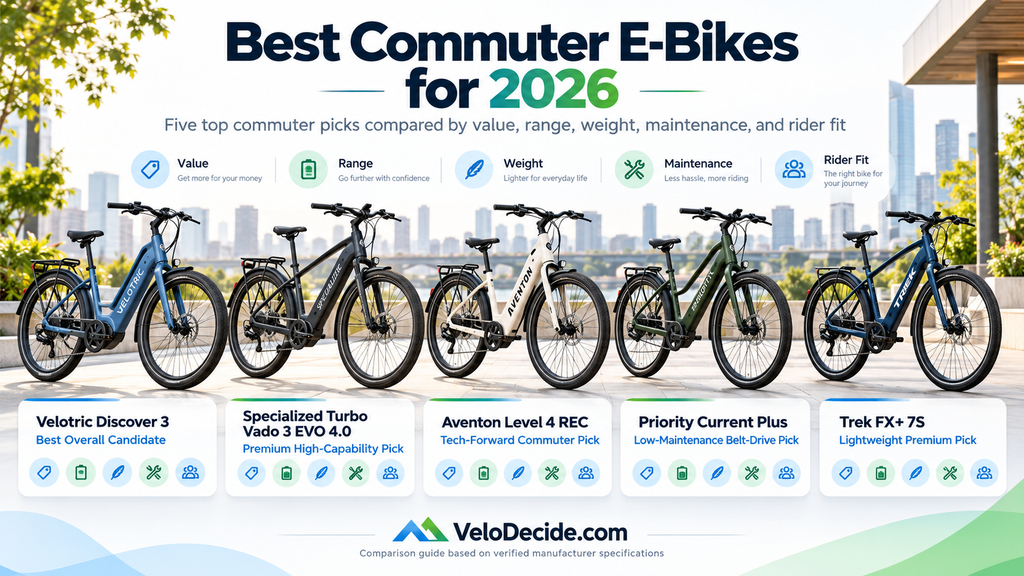
Table of Contents
- How We Chose the Best Commuter E-Bikes
- Compare Our Top Commuter E-Bike Picks
- Which Commuter E-Bike Is Right for You?
- How to Choose the Right Commuter E-Bike
- Frequently Asked Questions About Commuter E-Bikes
How We Chose the Best Commuter E-Bikes
We compared current product specifications, commuter-focused features, safety certification, weight, claimed range, drivetrain design, pricing, maintenance requirements, and likely buyer fit. We also consider important limitations so you can see where each bike may not suit your commute.
Disclosure: VeloDecide may earn a commission if you purchase through some links on this page, at no extra cost to you. Affiliate availability does not determine which bikes we include or how we evaluate them.
Our Quick Picks
- Velotric Discover 3 — Best Overall Candidate (read our in-depth Discover 3 review)
- Specialized Turbo Vado 3 EVO 4.0 — Premium High-Capability Pick
- Aventon Level 4 REC — Tech-Forward Commuter Pick
- Priority Current Plus — Low-Maintenance Belt-Drive Pick
- Trek FX+ 7S — Lightweight Premium Pick
Compare Our Top Commuter E-Bike Picks
Use this table to compare five of the best commuter e-bikes for different budgets, riding styles, and daily commuting needs.
On mobile, swipe horizontally to view the full comparison table.
| Bike | Price* | Motor / Torque | Battery | Claimed Range | Weight | Best Fit |
| Velotric Discover 3 | $1,999 | 750W / 75 Nm | 730Wh | Up to 80 mi | 61 lb | Everyday comfort & value |
| Specialized Turbo Vado 3 EVO 4.0 | $4,499.99 | 810W / 105 Nm | 840Wh | Up to 93 mi | 28.7 kg / 63 lb (size M, manufacturer-reported) | Premium / high-capability |
| Aventon Level 4 REC | $1,999 | Hub / 80 Nm, 96 Nm Boost | 733Wh | Up to 75 mi | 68.5 lb | Tech-forward commuting |
| Priority Current Plus | $3,299+ | 500W mid-drive / up to 140 Nm | 720Wh | 20–75 mi | 55–56.5 lb | Low-maintenance / belt drive |
| Trek FX+ 7S | See current Trek price (sale prices vary) | 250W TQ mid-drive / 50 Nm | 360Wh | Up to 50 mi | 18.70 kg / 41.23 lb (size M, manufacturer-reported) | Lightweight / fitness-style |
*Prices are current reference prices from our latest verification and may change.
*Prices, availability, and manufacturer-stated range figures were checked during our latest product verification. Real-world range varies with rider weight, terrain, weather, assist level, speed, and cargo.
Which Commuter E-Bike Is Right for You?
Choosing the right commuter e-bike depends less on which model has the biggest numbers and more on how you actually ride.
If your priority is everyday comfort and value, the Velotric Discover 3 is the strongest all-round candidate in this group.
If you want a more premium, high-capability commuter with stronger performance and a more refined platform, the Specialized Turbo Vado 3 EVO 4.0 is the better fit.
If smart features and connected security matter most, the Aventon Level 4 REC stands out.
If low maintenance is your priority, especially if you prefer a belt-drive setup, the Priority Current Plus is the most distinctive option.
If low weight and a more natural, fitness-bike feel matter more than maximum battery capacity, the Trek FX+ 7S is the better match.
Below, we break down where each model fits best, what it does well, and what you should consider before buying.
Velotric Discover 3
Best for
Best for: Everyday commuting, comfort-focused riders, and buyers looking for a strong balance of range, features, and price.
Why It Stands Out
The Velotric Discover 3 stands out as a well-rounded commuter e-bike with a strong mix of comfort, range, utility, and everyday practicality. Its 750W motor, 75 Nm of torque, 730Wh battery, hydraulic brakes, integrated lighting, rear rack, and suspension setup make it suitable for riders who want one bike for commuting, errands, and regular city riding.
Key Specs
- Price: $1,999
- Motor: 750W nominal / 1,100W peak
- Torque: 75 Nm
- Battery: 730Wh
- Claimed range: Up to 80 miles
- Weight: 61 lb
- Brakes: Hydraulic disc
- Drivetrain: Shimano 8-speed
- Max load: 440 lb
- Rear rack capacity: 66 lb
- Safety: UL 2849 and UL 2271
What We Like
- Strong commuter-focused feature set
- Large battery for the price
- Comfortable upright riding position
- Hydraulic brakes and suspension
- Integrated rear rack and lights
- Broad rider-fit range
What to Consider
- At 61 lb, it is not a lightweight e-bike
- Riders who need to carry a bike upstairs may prefer a lighter model
- Manufacturer-stated range can be lower in real-world use depending on terrain, speed, assist level, rider weight, cargo, and weather
Who Should Buy It
The Discover 3 is a strong fit for riders who want a comfortable, practical commuter e-bike with enough range and utility for daily riding, errands, and occasional longer trips. It is especially attractive for buyers who value comfort and features more than low weight.
Specialized Turbo Vado 3 EVO 4.0
Best for
Best for: Premium commuters, longer rides, mixed-surface routes, and riders who value stronger performance and a more refined platform.
Why It Stands Out
The Specialized Turbo Vado 3 EVO 4.0 is the premium option in this group. Its 810W motor, 105 Nm of torque, 840Wh battery, suspension setup, integrated security features, and more performance-oriented design make it better suited to riders who want more capability than a typical city commuter.
Key Specs
- Price: $4,499.99
- Motor: Specialized 3.1
- Power: 810W
- Torque: 105 Nm
- Battery: 840Wh
- Claimed range: Up to about 93 miles
- Fork: SR Suntour suspension
- Brakes: Shimano hydraulic disc
- Drivetrain: Shimano CUES 9-speed
- Tires: 27.5 × 2.6 in
- Security: Turbo System Lock + Apple Find My
What We Like
- Strong motor and torque for hills and heavier use
- Large 840Wh battery
- Premium ride platform
- Good fit for longer commutes
- Strong integrated security features
- Better suited to mixed city and rough-road riding than many standard commuters
What to Consider
- Much more expensive than the mainstream options in this guide
- More bike than many short-distance urban commuters actually need
- Larger tires and suspension make it less minimalist than lightweight city bikes
- Manufacturer-stated range depends heavily on assist level, terrain, rider weight, speed, and weather.
Who Should Buy It
The Vado 3 EVO 4.0 is best suited to riders who commute longer distances, regularly face hills or rougher roads, and are willing to pay more for performance, refinement, battery capacity, and a premium ownership experience.
Aventon Level 4 REC
Best for
Best for: Urban commuters who value smart security features, connected technology, strong everyday performance, and a feature-rich riding experience.
Why It Stands Out
The Aventon Level 4 REC combines practical commuter performance with one of the strongest connected feature sets in this group. Its hub motor delivers 80 Nm of torque, with up to 96 Nm in Boost mode, while the 733Wh battery supports longer daily rides. Built-in 4G/GPS connectivity, electronic locking, and unusual-activity detection make it especially appealing to riders concerned about security and bike tracking.
Key Specs
- Price: $1,999
- Motor: Rear hub motor
- Torque: 80 Nm, up to 96 Nm in Boost mode
- Battery: 733Wh
- Claimed range: Up to 75 miles
- Weight: 68.5 lb
- Fork: 80 mm suspension
- Brakes: Tektro hydraulic disc
- Drivetrain: Shimano 8-speed
- Safety: UL 2849 and UL 2271
- Smart features: 4G/GPS, E-lock, unusual-activity detection
What We Like
- Strong value around the $2,000 price point
- Excellent connected security features
- Large battery for daily commuting
- Hydraulic brakes and suspension
- Strong torque for urban riding and moderate hills
- Clear commuter-focused design
What to Consider
- At 68.5 lb, it is one of the heavier bikes in this comparison
- Riders who frequently carry their bike upstairs may find the weight inconvenient
- Smart features may matter less to buyers who prefer a simpler e-bike
- Manufacturer-stated range varies with terrain, assist level, rider weight, cargo, speed, and weather
Who Should Buy It
The Aventon Level 4 REC is best suited to commuters who want strong everyday performance but place extra value on security, GPS connectivity, and integrated smart features. It is especially compelling for riders who regularly park their bike in public areas and want more built-in protection than a conventional commuter e-bike provides.
Priority Current Plus
Best for: Commuters who prioritize low maintenance, strong hill-climbing capability, and a clean belt-drive setup for daily riding.
Why It Stands Out
The Priority Current Plus takes a different approach from most commuter e-bikes in this guide. Instead of relying on a conventional chain drivetrain, it uses a Gates belt drive paired with either Shimano or Enviolo internal gearing. Its 500W mid-drive motor delivers up to 140 Nm of torque, while the 720Wh battery supports longer daily rides. The result is a commuter aimed at riders who want strong performance with less drivetrain maintenance.
Key Specs
- Price: $3,299+
- Motor: 500W mid-drive
- Torque: Up to 140 Nm
- Battery: 720Wh
- Claimed range: 20–75 miles
- Weight: 55 lb Shimano / 56.5 lb Enviolo
- Drivetrain: Gates belt drive
- Gearing: Shimano or Enviolo internal gearing
- Max assist speed: Up to 28 mph
- Brakes: Hydraulic disc
- Intended use: Everyday commuting and touring
What We Like
- Belt drive requires less routine maintenance than a conventional chain
- Strong mid-drive torque for hills and heavier riding
- Large 720Wh battery
- Internal gearing keeps the drivetrain clean and commuter-friendly
- Good balance between premium features and practical daily use
- More distinctive than many hub-motor commuter e-bikes
What to Consider
- Higher price than mainstream commuter models around $2,000
- Some riders may prefer the simplicity of a conventional derailleur drivetrain
- Belt-drive and internal gearing systems can be less familiar to local bike shops
- Manufacturer-stated range varies significantly with terrain, assist level, rider weight, speed, and cargo
Who Should Buy It
The Priority Current Plus is a strong fit for riders who commute frequently and want to minimize routine drivetrain maintenance. It is especially appealing for commuters who face hills, ride longer distances, or prefer the clean and quiet operation of a belt-drive system.
Trek FX+ 7S
Best for
Best for: Riders who prioritize low weight, easy handling, a more natural bike-like feel, and fitness-oriented urban commuting.
Why It Stands Out
The Trek FX+ 7S stands apart from the heavier commuter e-bikes in this guide because of its relatively low weight and more conventional bicycle-like riding experience. At around 40 lb, it is significantly easier to handle, store, and carry than many full-size commuter e-bikes. Its 360Wh battery and more restrained electric system trade some range and outright power for lower weight and a cleaner, more agile ride.
Key Specs
- Current reference price: See current Trek price (sale prices vary)
- Torque: 50 Nm
- Battery: 360Wh
- Claimed range: Up to 50 miles
- Claimed range with optional range extender: Up to about 75 miles
- Weight: About 40 lb
- Max assist speed: Up to 28 mph
- Riding position: Active / fitness-oriented
- Safety: E-system tested for UL 2849 compliance
- Lifecycle status: Closeout
What We Like
- Much lighter than most commuter e-bikes in this comparison
- Easier to carry, store, and maneuver
- More natural bicycle-like riding feel
- Good option for apartment dwellers and riders with limited storage space
- Premium integrated design
- Strong fit for riders who want electric assistance without a bulky e-bike feel
What to Consider
- Smaller 360Wh battery than the other main picks
- Less suitable for riders prioritizing maximum range or high torque
- Active riding position may not suit riders who prefer a relaxed upright posture
- Current closeout status means availability may become limited or change quickly
- Higher price than some more powerful mainstream commuter models
Who Should Buy It
The Trek FX+ 7S is best suited to riders who want an e-bike that still feels relatively close to a conventional fitness or hybrid bike. It makes particular sense for commuters who need to carry or store their bike frequently and who value low weight and agile handling more than maximum battery capacity or motor output.
Availability note: The FX+ 7S is currently listed as a closeout model, so pricing and stock may change quickly.
How to Choose the Right Commuter E-Bike
How Much Range Do You Actually Need?
For most daily commuters, the advertised maximum range matters less than whether the bike can comfortably cover a normal round trip with reserve capacity.
A useful rule is to choose a bike with more claimed range than your typical commute requires, because real-world range can drop with higher assist levels, hills, cold weather, rider weight, cargo, frequent stops, and faster speeds.
For example:
- Short urban commute: around 10–20 miles per day
- Moderate commute: around 20–40 miles per day
- Longer commute: 40+ miles per day
If your commute is long or includes hills, a larger battery can provide more useful reserve than chasing maximum motor power alone.
Weight Matters More Than Many Buyers Expect
A heavy e-bike can feel stable and comfortable on the road, but weight becomes important if you need to:
- Carry the bike upstairs
- Lift it onto a vehicle rack
- Store it inside an apartment
- Move it through narrow spaces
- Ride without motor assistance
This is where lighter bikes such as the Trek FX+ 7S can make more sense, even if they offer less battery capacity than heavier commuter models.
Hub Motor vs. Mid-Drive
Hub-motor commuter e-bikes are common because they can provide strong performance at competitive prices and are relatively simple.
Mid-drive systems place the motor near the crank and can feel more natural while also using the bike’s gearing more effectively on hills.
In practical terms:
- Hub drive: often better value, simple, strong everyday performance
- Mid-drive: often better climbing feel, balance, and premium ride quality
Neither system is automatically better. The right choice depends on terrain, budget, maintenance preference, and riding style.
Think About Maintenance Before You Buy
Traditional chain-and-derailleur systems are familiar and easy to service, but they require cleaning, lubrication, and periodic adjustment.
Belt-drive systems such as the setup used on the Priority Current Plus can reduce routine drivetrain maintenance and operate more quietly.
For riders who commute frequently in rain, dust, or dirty urban conditions, lower-maintenance drivetrains can be especially useful.
Look for Commuter-Ready Features
A practical commuter e-bike should ideally include or support:
- Fenders
- Front and rear lights
- Rear rack
- Hydraulic disc brakes
- Kickstand
- Good tire puncture protection
- Integrated security features
- Useful cargo capacity
Buying these features separately can increase both cost and setup time.
Do Not Ignore Security
E-bikes are expensive and attractive theft targets, especially in urban areas.
Useful security features can include:
- GPS tracking
- Electronic locking
- Apple Find My integration
- Passcode protection
- Frame locks
- Strong physical locks
Built-in technology should complement, not replace, a high-quality physical lock.
What About E-Bike Class?
For commuting, Class 1, Class 2, and Class 3 e-bikes can all make sense depending on local rules and your route.
Class 1 bikes provide pedal assist up to 20 mph. Class 2 models typically add throttle assistance up to 20 mph. Class 3 e-bikes can provide pedal assistance up to 28 mph.
Before buying, check the rules that apply to the roads, bike lanes, and trails you actually use. A faster bike is not automatically more useful if your normal route restricts where you can ride it.
How Much Should You Spend?
A commuter e-bike does not need to be the most expensive bike in the category to work well.
As a rough buying framework:
- Around $1,500–$2,000: strong mainstream commuter options
- Around $2,000–$3,500: more refined components, larger batteries, mid-drive systems, or lower-maintenance drivetrains
- $3,500+: premium brands, more sophisticated drive systems, lighter platforms, or higher-end integration
The best value depends on which features you will actually use every day.
Our Buying Advice
Start with five questions:
- How many miles do you ride on a normal day?
- Do you need to carry the bike upstairs or lift it often?
- Is your route mostly flat or hilly?
- Do you prefer low maintenance or lower upfront cost?
- How important are security, cargo capacity, and integrated accessories?
Once those answers are clear, the shortlist usually becomes much smaller.
You can also read our How to Choose an E-Bike guide for a broader overview of fit, range, motor type, and riding needs.
Frequently Asked Questions About Commuter E-Bikes
How much should I spend on a commuter e-bike?
For most buyers, a practical commuter e-bike budget starts around the mid-$1,000 range and extends into the $3,000+ range depending on the type of motor, battery size, drivetrain, brand, and integrated features.
Around $1,500–$2,000, you can already find strong mainstream commuter options with hydraulic brakes, useful range, integrated lights, and commuter-ready features.
As you move above $2,000, you are more likely to see larger batteries, better ride refinement, mid-drive systems, lower-maintenance drivetrains, stronger dealer support, or more advanced security features.
Spending more does not automatically mean the bike is a better commuter for you. The better question is whether you are paying for features you will actually use every day.
How much range do I need for commuting?
Start with your actual round-trip distance, then add a safety margin.
If your normal commute is 15 miles round trip, a bike with a real-world usable range comfortably above that distance is more important than chasing the highest advertised range figure.
Manufacturer-stated range is usually measured under favorable conditions. Real-world range can be lower because of:
- Higher assist levels
- Hills
- Cold weather
- Rider weight
- Cargo
- Frequent stops
- Headwinds
- Higher speeds
A useful approach is to avoid planning your daily commute around the maximum advertised range. Having reserve capacity reduces range anxiety and gives you more flexibility when conditions are less favorable.
Is a 750W motor necessary for commuting?
Not necessarily.
A 750W motor can provide strong acceleration and useful assistance on hills, especially for heavier riders or bikes carrying cargo. But motor wattage alone does not determine how well an e-bike performs.
Torque, motor type, gearing, bike weight, controller tuning, and rider input also matter.
For flat urban routes, a lower-powered system may provide more than enough assistance while keeping the bike lighter and more efficient.
For hillier routes, heavier loads, or riders who want stronger acceleration, a more powerful motor can be useful.
The right motor is the one that matches your terrain and riding needs, not simply the largest number on the specification sheet.
Are lighter e-bikes better for commuting?
They can be, especially if you need to carry, store, or maneuver the bike frequently.
A lighter commuter e-bike is easier to:
- Carry upstairs
- Lift onto a rack
- Move through an apartment
- Maneuver in tight spaces
- Pedal without assistance
However, lower weight often comes with trade-offs such as a smaller battery, less suspension, reduced cargo capacity, or a less powerful motor.
Heavier commuter e-bikes can feel more stable and may offer larger batteries, more comfort features, and stronger utility.
If your bike will stay on the ground and you prioritize comfort and range, weight may matter less. If stairs or storage are part of your daily routine, weight can become one of the most important buying factors.
Is a belt-drive e-bike worth it?
A belt-drive e-bike can be worth the extra cost for riders who value low maintenance, quiet operation, and a cleaner drivetrain.
Unlike a traditional chain, a belt does not require regular lubrication and is less likely to leave grease on clothing. Belt systems can also last a long time when properly maintained.
The trade-offs are usually:
- Higher initial cost
- Fewer local shops familiar with some belt/internal gear systems
- Less flexibility for drivetrain modifications
- More specialized replacement parts
For daily commuters who ride frequently or in wet and dirty conditions, the lower-maintenance benefit can be significant.
What class of e-bike is best for commuting?
There is no single best e-bike class for every commuter.
In general:
- Class 1 provides pedal assist up to 20 mph
- Class 2 typically adds throttle assistance up to 20 mph
- Class 3 provides pedal assist up to 28 mph
Class 1 can be a good fit for riders who use bike paths and prefer a more bicycle-like riding experience.
Class 2 can be useful for riders who want throttle assistance for starts, traffic, or short sections where they do not want to pedal.
Class 3 can be valuable for longer commutes or riders who want higher assisted speeds.
Local rules matter. Some bike paths, trails, or jurisdictions restrict certain e-bike classes, so check the rules that apply to your actual route before choosing a faster model.
How often should commuter e-bikes be serviced?
Service frequency depends on how often you ride, weather conditions, road quality, and the type of drivetrain.
For regular commuting, it is sensible to inspect the bike frequently and schedule periodic professional servicing.
Common items to monitor include:
- Brake pads and rotors
- Tire pressure and tire wear
- Chain or belt condition
- Drivetrain adjustment
- Wheel and spoke condition
- Fasteners
- Battery connections
- Lights and electronics
Chain-driven bikes generally require more routine cleaning and lubrication than belt-drive systems.
If you ride daily, in rain, or on rough roads, maintenance intervals may need to be shorter. Follow the manufacturer’s service recommendations and address unusual noises, braking changes, or drivetrain problems early rather than waiting for them to become expensive little surprises.
Final Thoughts
There is no single commuter e-bike that is best for every rider.
The Velotric Discover 3 is a strong all-round option for comfort and everyday value. The Specialized Turbo Vado 3 EVO 4.0 suits riders looking for a more premium and capable platform. The Aventon Level 4 REC stands out for connected security features, while the Priority Current Plus offers a compelling low-maintenance belt-drive setup. The Trek FX+ 7S makes the most sense for riders who place a high value on lower weight and a more natural bike-like feel.
The best choice is the bike that fits your route, storage situation, maintenance preferences, budget, and riding style.